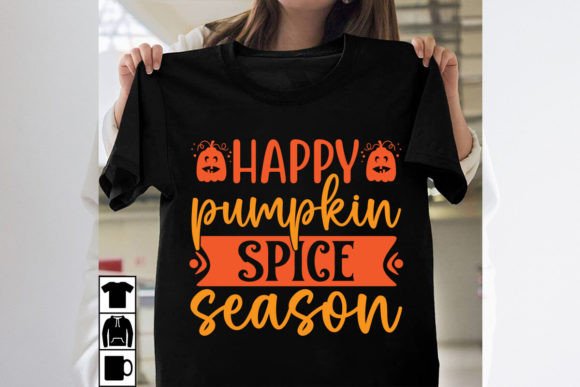
Reviewing Happy Pumpkin Spice Season for Embroidery
As a designer who spends half my life digitizing and the other half stitching, I have learned to look past the glossy mockups. When I first pulled up Happy Pumpkin Spice Season, my initial reaction was one of cautious optimism. The phrase itself carries a heavy cultural weight in the autumn months, evoking warmth, nostalgia, and the cozy transition into holiday mode. But as an embroidery product reviewer, I am not interested in the sentiment alone; I am interested in how that sentiment translates into thread, tension, and texture on actual fabric.
This design arrives as part of a bundle labeled as a Thanksgiving SVG T-shirt design, which immediately signals its primary intent: print-on-demand or heat transfer vinyl applications. However, the inclusion of high-resolution PNG files and fully editable EPS vectors opens the door for us embroidery professionals to adapt it for machine work. The question is not whether it looks good on a screen, but whether it holds up under the needle.
The Visual Personality and Layout
The mood of Happy Pumpkin Spice Season is undeniably trendy. It leans into the "cozy core" aesthetic that dominates social media feeds from September through November. Visually, the layout appears balanced, likely featuring playful typography paired with seasonal motifs such as pumpkins, leaves, or steam rising from a mug. For an embroidery project, this combination of text and iconography is classic, but it requires careful handling.
In my experience, designs that mix bold lettering with detailed graphics can be tricky. If the font is too thin, it may disappear into the fabric pile. If the graphic elements are too dense, they create a stiff patch that pulls on the garment. Upon inspecting the provided assets, particularly the 300 dpi transparent PNGs, the lines appear clean. This suggests that if you were to auto-digitize or manually trace this into a machine embroidery design, you would have a solid foundation. The clarity of the source file is crucial for maintaining the integrity of small details like leaf veins or the curve of a pumpkin stem.
Real-World Application: The Tote Bag Test
To truly evaluate this graphic, I imagined a specific real-life scenario: a custom embroidered tote bag for a local boutique’s fall launch. Tote bags are typically made from canvas or heavy cotton duck, which provides a stable base for stitching. Here, Happy Pumpkin Spice Season shines. The boldness of the message works well on a larger surface area.
If I were stitching this onto a 15-inch hoop, I would likely scale the design to maximize visibility without overcrowding the fabric. The contrast between the thread colors and the natural beige of the canvas would be key. Using warm tones—burnt orange, deep brown, and cream—would enhance the "spice" theme. However, because the original package includes PNG files in color, white, and black, I have the flexibility to test these contrasts digitally before threading the machine. This is a significant advantage for craft business owners who need to visualize the finished product quickly for client approvals.
Navigating Fabric and Hoop Constraints
While the design works beautifully on sturdy tote bags, I would exercise caution when applying it to more challenging materials. For instance, using Happy Pumpkin Spice Season on a stretchy sweatshirt requires a different approach. Sweatshirts are popular for holiday embroidery, but the fabric moves. If the stitch density is too high, the design will pucker. If it is too loose, the fabric will show through.
For curved surfaces like caps or hats, this design might be problematic depending on the width of the text. Caps have a limited embroidery field, usually around 2.5 inches in height. If the phrase is arranged in a single long line, it may not fit without significant resizing, which could render the text illegible. In such cases, I would recommend breaking the design into two lines or focusing solely on the graphic element if the software allows for easy separation via the EPS file.
Thin fabrics present another hurdle. If a customer requests this on a lightweight baby onesie or a silk scarf, the weight of the thread could distort the garment. In these instances, using a cut-away stabilizer is non-negotiable. Additionally, I would advise reducing the stitch count by simplifying any intricate fill stitches into satin stitches where possible, though this requires manual digitizing expertise.
Commercial Viability and Brand Trust
For Etsy sellers and small shop owners, the perceived value of a handmade product is tied directly to its execution. A sloppy stitch-out of a trendy phrase like Happy Pumpkin Spice Season can damage brand consistency. Customers expect crisp edges and clean color transitions. Because this bundle provides editable EPS files, it offers a level of professional control that pre-digitized files sometimes lack. You can adjust the paths to ensure smooth curves and optimal stitch direction.
However, it is vital to remember the source. This is marketed primarily as a T-Shirt Design bundle. Before selling finished items, you must verify the licensing terms. Does the creator allow commercial use for physical embroidered goods? Often, licenses for print-ready PNGs differ from those for machine embroidery files. Assuming permission is granted, the versatility of having both black and white versions allows for creative adaptations. A white-on-black version could look striking on a dark navy hoodie, creating a sophisticated, minimalist look that appeals to a broader audience than just the typical autumn enthusiast.
Practical Notes for the Embroiderer
Before committing to a full production run, follow these steps:
- Test on Scrap Fabric: Always stitch a sample on the exact fabric type you intend to use. Check for puckering or thread breaks.
- Check Thread Contrast: Use the provided PNGs to mock up different thread color combinations. Ensure the text remains readable against the background.
- Review Stitch Density: If you are digitizing this yourself from the EPS, pay close attention to the density in the pumpkin or graphic areas. Too much density creates a hard, cardboard-like feel.
- Confirm Hoop Size: Ensure the scaled design fits comfortably within your machine’s hoop, leaving at least an inch of margin for stability.
- Inspect Small Details: Zoom in on the EPS file. Are there tiny anchor points or stray nodes that could cause needle jumps? Clean up the vector before digitizing.
In conclusion, Happy Pumpkin Spice Season is a strong candidate for autumn-themed projects, provided it is adapted with care. It captures the zeitgeist of the season effectively, but its success in embroidery depends on the skill of the operator and the suitability of the substrate. For tote bags, aprons, and heavy cotton garments, it is a winner. For delicate or curved items, it requires thoughtful modification. As always, let the quality of your stitch-out speak louder than the trendiness of the phrase.