Reviewing the I Love My Big Brother SVG for Embroidery
As a designer who spends half my life staring at digitized stitch paths and the other half troubleshooting tension issues on actual fabric, I approach every new graphic with a healthy dose of skepticism. We see thousands of files labeled as "ready to cut" or "print-ready," but when it comes to translating a flat digital image into a textured machine embroidery design, the gap between expectation and reality can be wide. Recently, I pulled the I Love My Big Brother SVG Cut File from my asset library to evaluate its potential for a client’s upcoming boutique line. What follows is my practical assessment of how this graphic holds up when moved from the screen to the needle.
First Impressions and Visual Personality
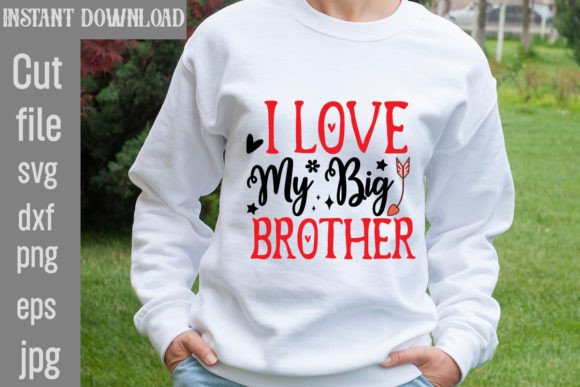
The immediate appeal of this design lies in its simplicity. In the world of T-Shirt Designs, clutter is the enemy of clarity. This file presents a clean, bold statement that relies on strong typography and minimal decorative elements. For an embroidery project, this is often a blessing. Complex gradients and tiny details rarely survive the translation to thread, but broad shapes and clear lines thrive. The mood is playful yet structured, making it ideal for personalized gifts that need to look professional rather than homemade in the chaotic sense.
When I opened the included PNG file to check the resolution, the 300 DPI transparent background offered a crisp preview. However, as an experienced reviewer, I know that a PNG is merely a visual reference. The real work begins with the vector files. The package includes SVG, DXF, and EPS formats, which is standard for cutting machines like Cricut and Silhouette. For embroidery, these vectors are crucial because they allow us to trace clean paths for satin stitches or define boundaries for fill stitches without pixelation.
Real-World Application: The Sweatshirt Test
To truly judge a design, you must imagine it on a specific product. I envisioned this graphic on a heather grey youth-sized sweatshirt. This is a common request for custom apparel shops, especially around back-to-school seasons or family reunions. The "Big Brother" theme suggests a target audience of children and parents, meaning durability and comfort are paramount.
In this scenario, the design’s open spacing works in our favor. If we were to digitize this for embroidery, we would likely use a combination of satin stitch for the text borders and a light fill stitch for any solid graphical elements. Because the design is not overly dense, it avoids the "cardboard effect" where too many stitches make the fabric stiff and uncomfortable against a child’s skin. This is a critical consideration for baby embroidery and kids' wear. A heavy, dense design on a soft fleece sweatshirt would ruin the drape and feel of the garment, potentially leading to customer returns.
Navigating Fabric and Hoop Constraints
While the design is versatile, it is not without its limitations. I would exercise caution when applying this to curved surfaces like caps. The horizontal layout of the text might distort if not properly punched with pull compensation. Furthermore, on stretchy fabrics like jersey knits, the stability of the text depends entirely on your choice of stabilizer. A cut-away stabilizer would be non-negotiable here to prevent the letters from puckering after washing.
Another factor is hoop size. While the design appears compact, you must verify the actual dimensions in your digitizing software before committing to a small hoop, such as a 4x4 inch frame. If the text is too small, the legibility suffers, and the machine may struggle with tight turns in the lettering. I always recommend testing the design on scrap fabric first. This allows you to check thread color contrast and ensure that the stitch density is appropriate for the specific material you are using.
Commercial Viability for Etsy Sellers
For Etsy sellers and small shop owners, the value of a design lies in its marketability. The "Big Brother" niche is evergreen. Parents love buying matching sets or milestone items. Using this graphic as a base for an embroidered patch could be a smart pivot. Patches allow for higher stitch density and more vibrant colors since they are applied to a stable backing, removing the worry about fabric stretch. This transforms the digital embroidery file from a simple shirt print into a versatile design asset that can be sold as a finished product or used in commercial embroidery projects.
However, a word of caution regarding licensing. The product description states this is a DIGITAL DOWNLOAD ONLY containing SVG, DXF, EPS, and PNG files. It does not explicitly state that these are pre-digitized embroidery files (such as PES, DST, or JEF). This is a vital distinction. As a designer, I must clarify that you will likely need to use these vector files to create the embroidery path yourself or hire a digitizer. You cannot simply load an SVG into most embroidery machines. Always confirm the license terms before selling finished items. Most cut-file licenses allow for physical product sales, but you must ensure you are not redistributing the digital file itself.
Enhancing Visual Appeal and Brand Trust
The professionalism of your handmade product hinges on execution. A clean design like this builds customer trust because it looks intentional. When a buyer receives a personalized gift with crisp, well-spaced lettering, they perceive higher value. Conversely, messy stitching or poor color choices can undermine even the best graphic. I recommend using high-contrast thread colors against the fabric. For example, navy thread on white cotton or gold thread on black fleece creates a striking visual that photographs well for printable mockup previews and social media marketing.
Additionally, consider the context of holiday embroidery. This design could easily be adapted for Christmas pajamas or Easter outfits by changing the thread palette. The versatility of the underlying Graphics allows for seasonal pivots without needing a new design file. This efficiency is key for craft business owners who need to rotate inventory quickly.
Final Designer Notes
Before you commit to a large production run, take these practical steps:
- Digitize Carefully: Use the EPS or SVG to trace clean vectors. Avoid auto-digitizing if possible, as it often creates unnecessary jump stitches.
- Test on Similar Fabric: If you are selling tote bag designs, test on canvas. If selling shirts, test on cotton jersey. The fabric texture changes how the stitch sits.
- Check Small Details: Ensure that any small decorative elements in the design are large enough to be stitched without breaking the thread.
- Verify Licensing: Confirm with the creator if commercial use of the physical embroidered item is permitted under the current license.
The I Love My Big Brother SVG Cut File is a solid foundation for a variety of embroidery projects. It is not a magic bullet, but with proper digitizing and attention to fabric choice, it can become a bestseller in your small shop product lineup. Treat it as a raw material, not a finished solution, and you will find it serves your creative and commercial needs well.